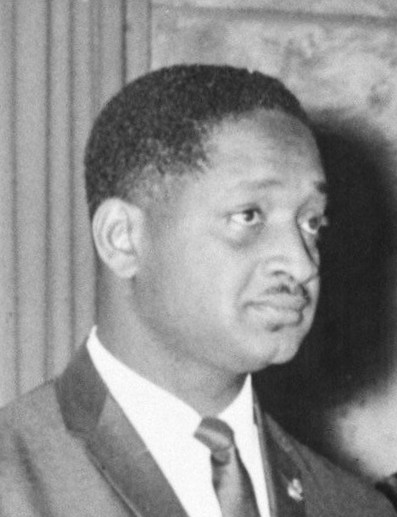
20 February 1923 — 6 August 1985
“We are a small country but we are not a small people.”
There was nothing small about Forbes Burnham. Not his voice, not his vision, not the way he commanded a room before he had said a single word. He was born on 20 February 1923 in Kitty, a suburb of Georgetown, to James Ethelbert Burnham, a schoolmaster, and Rachel Abigail Sampson. The household was Methodist, disciplined, and anchored in the belief that education was the way out and the way up.
From an early age, Burnham was brilliant. He attended Kitty Methodist School, then Central High School, before winning a place at the prestigious Queen's College in Georgetown. He did not simply attend — he dominated. He won the Guiana Scholarship, the colony's highest academic prize, which took him to the University of London to read law. He returned in 1949 with a degree, a barrister's qualification, and a burning conviction that British Guiana belonged to its people, not to the Crown.
He was tall, eloquent, and fearless. People who met him in those early years said there was something inevitable about him — as if the country was simply waiting for him to step forward.
In 1950, Burnham co-founded the People's Progressive Party alongside Cheddi Jagan, uniting the country's two largest ethnic communities behind one anti-colonial movement. It was an act of political courage that shook the British establishment. When the PPP won the 1953 elections in a landslide, the British suspended the constitution within 133 days, terrified of the movement they had unleashed.
By 1955, Burnham and Jagan had parted ways. Burnham formed the People's National Congress, and the two men would spend the next four decades as rivals. But it was Burnham who led British Guiana to independence on 26 May 1966. That date — Guyana's birthday — belongs to every Guyanese person alive, and Burnham was the man who delivered it.
As Prime Minister and then President, he transformed the nation. He nationalised the foreign-owned bauxite mines and sugar plantations, insisting that Guyana's natural wealth should belong to Guyanese people. He declared Guyana a Co-operative Republic, enshrining the idea that the nation would be built collectively. He co-founded the Caribbean Free Trade Association (CARIFTA), which later became CARICOM — the regional body that binds Caribbean nations together to this day.
He made education free from nursery to university. He expanded healthcare to the interior. He gave Guyana a seat at the table of the Non-Aligned Movement, standing alongside the great leaders of the developing world.
Beyond the political arena, Burnham was a voracious reader and a gifted orator. He could quote Shakespeare, recite Caribbean poetry, and deliver a two-hour speech without notes that held an audience spellbound. He was a family man who married twice — first to Sheila Latham and then to Viola Harper — and had several children.
He was deeply invested in the cultural life of the nation. He championed Mashramani, Guyana's republic celebration, and promoted Guyanese art, music, and literature at a time when the Caribbean was still finding its cultural voice. He believed that political independence meant nothing without cultural pride.
Forbes Burnham died on 6 August 1985, during throat surgery at Georgetown Hospital. He was 62 years old. The nation he had built grieved openly.
His legacy is complex, as any nation-builder's must be. But certain facts are beyond dispute: he took a British colony and turned it into an independent republic. He gave Guyanese people ownership of their own resources. He insisted that a small Caribbean nation could stand on its own two feet and speak with its own voice on the world stage. He co-created the regional architecture that Caribbean nations still rely on today.
Burnham's fingerprints are on the very foundations of modern Guyana. Every time a Guyanese child walks into a public school, every time the green, gold, and red flag is raised, every time CARICOM convenes — his vision is alive.
No photographs uploaded yet.
