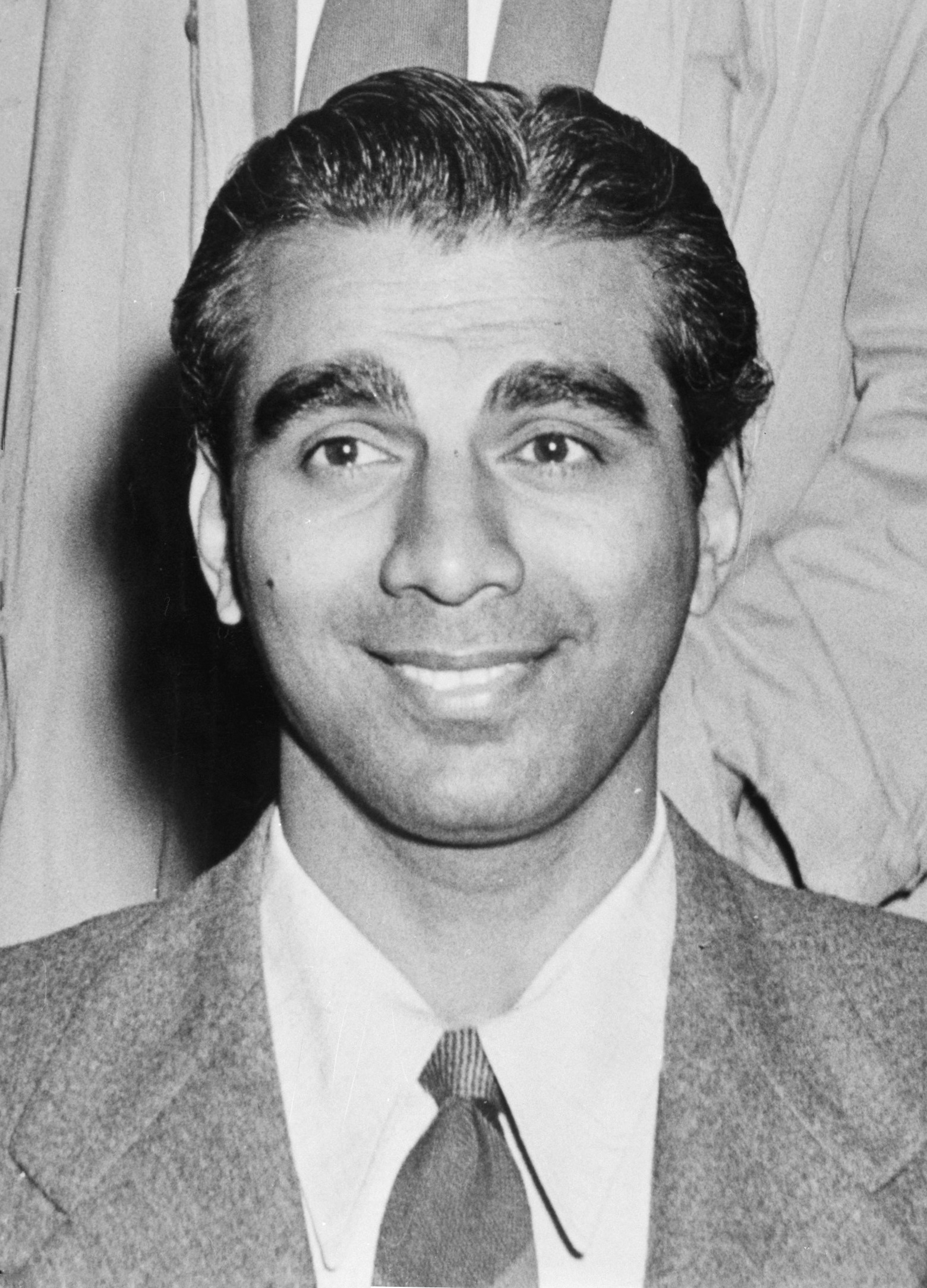
22 March 1918 — 6 March 1997
“We must have the courage to think new thoughts, to blaze new trails.”
Cheddi Jagan came from the cane fields. Not as a metaphor — literally. He was born on 22 March 1918 on a sugar plantation in Port Mourant, Berbice, the eldest son of indentured labourers who had arrived in British Guiana from Uttar Pradesh, India, as young children with their mothers. His father cut cane. His mother worked the estate. The family lived in the logies — the plantation barracks built for the workers the British had shipped across the ocean to replace the enslaved.
But his father had a vision. He scraped together five hundred dollars — the family's entire life savings — and sent young Cheddi to the United States, so that his son would never have to bend his back in the cane fields and would never have to compromise his Hindu faith. It was 1936. Cheddi Jagan was eighteen years old.
That journey — from the sugar estates of Berbice to the lecture halls of Washington, D.C. — would shape everything that followed. He would return to Guyana not just as a dentist, but as a man who had seen what was possible and was no longer willing to accept what was.
Jagan enrolled at Howard University in Washington, D.C., before transferring to Northwestern University in Chicago, where he earned his Doctor of Dental Surgery degree in 1942. In Chicago he met Janet Rosenberg, a young American activist and student nurse. They married in 1943. She would become his partner in everything — in politics, in struggle, in building a nation.
They returned to British Guiana and Jagan opened a dental practice in Georgetown. But the surgery was never just about teeth. It became a meeting place for workers, unionists, and anyone who believed that the colony's wealth should not flow out to London while its people lived in poverty. In 1950, together with Janet and Forbes Burnham, he founded the People's Progressive Party — the first mass political party in British Guiana's history.
In 1953, the PPP won the colony's first election held under universal adult suffrage in a landslide. Jagan became Chief Minister — the first person of Indian descent to lead a government outside the Indian subcontinent. The British were so alarmed that they suspended the constitution after just 133 days, sent warships to Georgetown, and threw Jagan in prison.
He came back. He always came back. He won again in 1957 and again in 1961, serving as Premier of British Guiana. The British and Americans conspired to remove him, funding strikes and civil unrest and changing the electoral system to proportional representation specifically to deny him power. He lost the 1964 election to Forbes Burnham and spent the next twenty-eight years in opposition — the longest stretch in the political wilderness of any major Caribbean leader.
In 1992, at the age of seventy-four, Cheddi Jagan won again. Guyana held its first free and fair election in decades, and the people chose him. As President, he inherited a broken economy and set about rebuilding it — cancelling debts, rehabilitating schools and health centres, and reviving the agricultural sector that had long been depressed.
Away from the political platform, Jagan was a man of simple habits and deep principle. He lived modestly — remarkably so for a head of state. He remained a practising Hindu throughout his life and drew strength from his faith. His partnership with Janet Jagan was one of the great political marriages of the twentieth century. She served as First Lady, as a government minister, and eventually as President of Guyana herself after his death — making them the only married couple in Caribbean history to both serve as head of state.
Jagan was a prolific writer, authoring several books including "Forbidden Freedom" and "The West on Trial", which documented the struggle for independence and the interference of colonial and Cold War powers in Guyana's affairs. He was a cricket lover, a man of the people, and by all accounts someone who never forgot where he came from — the sugar estates of Port Mourant, where the cane still grows.
Cheddi Jagan died on 6 March 1997 in Washington, D.C., just sixteen days before his seventy-ninth birthday. He had suffered a heart attack while still serving as President. The nation mourned deeply.
He is honoured as the Father of the Nation — the man who lit the fire of self-determination in a people who had been told for three hundred years that they could not govern themselves. The international airport in Georgetown bears his name. So does a research centre dedicated to preserving his legacy and the history of Guyana's independence movement.
What Jagan proved, above all else, was that you cannot silence a people forever. You can suspend constitutions, rig elections, imprison leaders, and change the rules — but the desire for justice and self-rule does not die. It waits. And when the moment comes, it wins.
No photographs uploaded yet.
